Research & Projects
2023 - Today: Master's Degree
Experimental Langendorff Isolated Rabbit Heart Platform for Body Surface Potential Mapping: A Translational Validation Study
Under the supervision of Prof. Dr. João Loures Salinet Júnior at HEartLab (UFABC), my research focuses on bridging the gap between invasive cardiac electrophysiology and non-invasive diagnostics. We developed and validated an advanced translational platform that uses ex-vivo Langendorff-perfused rabbit hearts to study the mechanisms of complex arrhythmias such as Atrial Fibrillation (AF) and Ventricular Fibrillation (VF).
The core of my work involves a synchronized multi-modal acquisition system. By suspending the heart in a specialized “torso-tank” chamber, I am able to correlate epicardial electrical propagation, acquired via optical mapping, directly with surface potentials and Invasive Multi-Electrode Arrays. This provides a robust framework for validating the translational capabilities of non-invasive interpretations of cardiac activity.
Beyond hardware integration, I apply advanced signal processing techniques—including Dominant Frequency (DF) analysis and Phase Mapping to characterize the spatiotemporal stability of arrhythmic rotors. This research is instrumental in improving the accuracy of non-invasive arrhythmia knowledge to localize triggers for cardiac ablation, ultimately aiming to enhance the treatment of cardiovascular diseases.
This project has led to multiple international collaborations and publications, including lead authorship on experimental studies presented at Computing in Cardiology (CinC) in 2024 and 2025, and co-authorship in the Journal of Physiology.
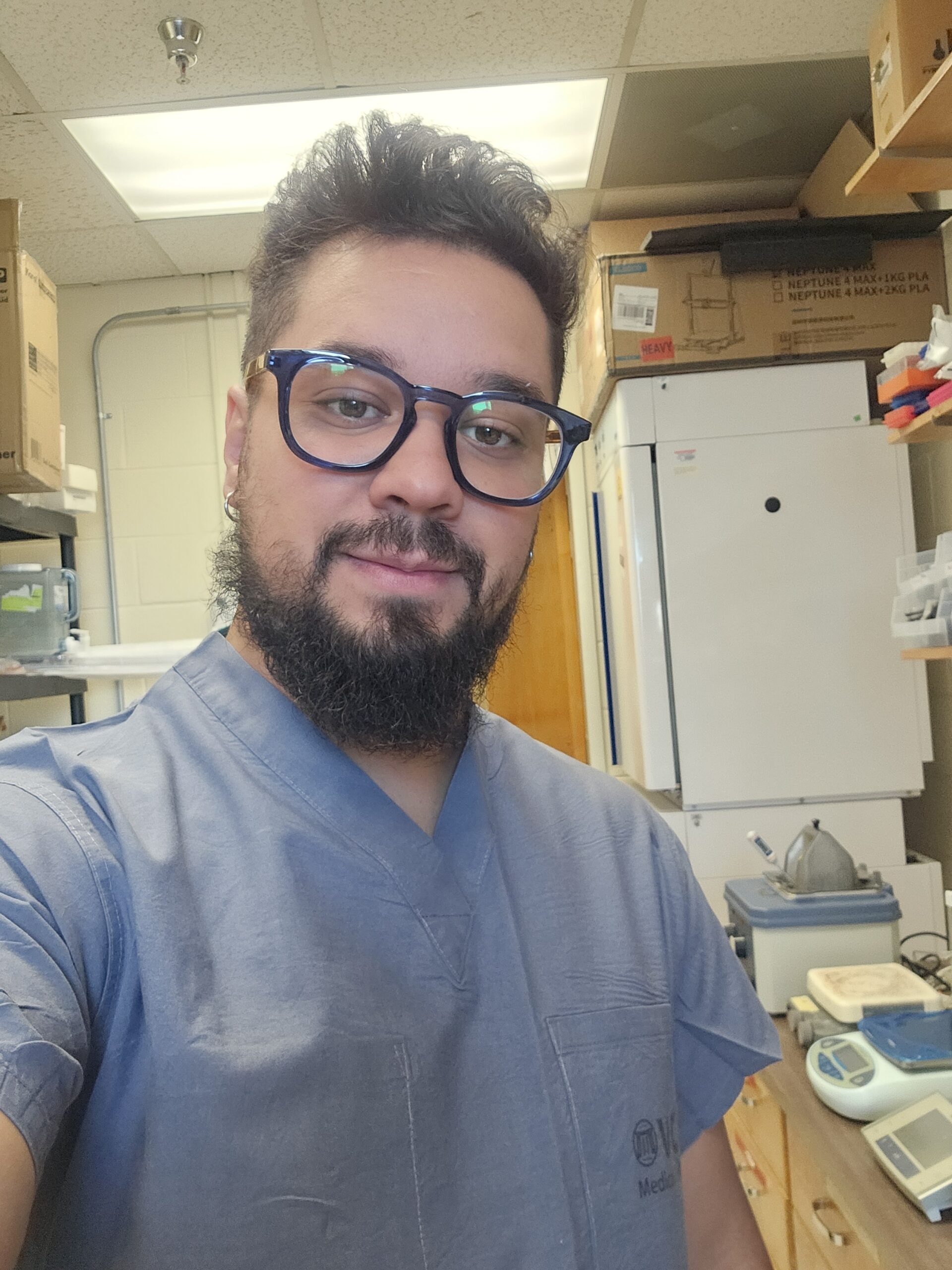
Research Internship at Virginia Commonwealth University (VCU) Health
During an international research period in Richmond, USA, I worked under the supervision of Dr. Ilija Uzelac at the VCU Health – Surgery Center. This experience allowed me to expand my technical expertise to high-complexity models, involving research with human explanted hearts and large animal models (pig hearts). My work focused on the integration of high-resolution dual-camera optical mapping with torso-mimetic Body Surface Potential Mapping to quantify the heart’s electrical response to ischemia using a langendorff reperfusion system
2018 - 2022: Molecular Biology & Bioinformatics Roots
As an undergraduate student in Biomedical Engineering, I conducted a some studies at UFABC – Virus Lab, under Supervision of Dra. Maria Cristina Carlan da Silva, focused on the UL111A gene of the Human Cytomegalovirus (HCMV). This work was pivotal in understanding how viral IL-10 isoforms manipulate the human immune response during both lytic and latent infection phases.
My activities spanned from foundational wet-lab techniques to advanced computational analysis. I specialized in the cloning and expression of vIL-10 transcripts (A, B, E, and F) and played a key role in the discovery of the novel transcript H. To achieve high-sensitivity detection and characterization, I used Nested PCR, Real-Time PCR (qPCR), and High-Performance Liquid Chromatography (HPLC).
Building on this experimental foundation, I led a FAPESP-funded project in Computational Biophysics. In this phase, I applied Molecular Modeling and Molecular Docking to analyze the interactions between viral isoforms and human receptors (cIL-10R1 and cIL-10R2), providing deeper insights into the virus’s immune evasion mechanisms.
The results of these projects have been shared through academic contributions. I co-authored a comprehensive review on HCMV IL-10 homologs in Frontiers in Cellular and Infection Microbiology (2020) and published a detailed study on molecular modelling and receptor interactions in PLOS ONE (2022). Additionally, I presented my findings regarding “vIL-10 Expression Patterns in GBM Tissues” at the XXXIII Congresso Brasileiro de Virologia in 2022.